
An extension of Diablo Canyon would saddle Californians with more than $2 billion in risk, advocates warn
Mothers for Peace and its allies call on California Governor Newsom, Speaker Rivas and Pro Tem Limón and Legislators to halt backroom negotiations and hold full public hearings before any vote to extend the nuclear plant’s life to 2045.
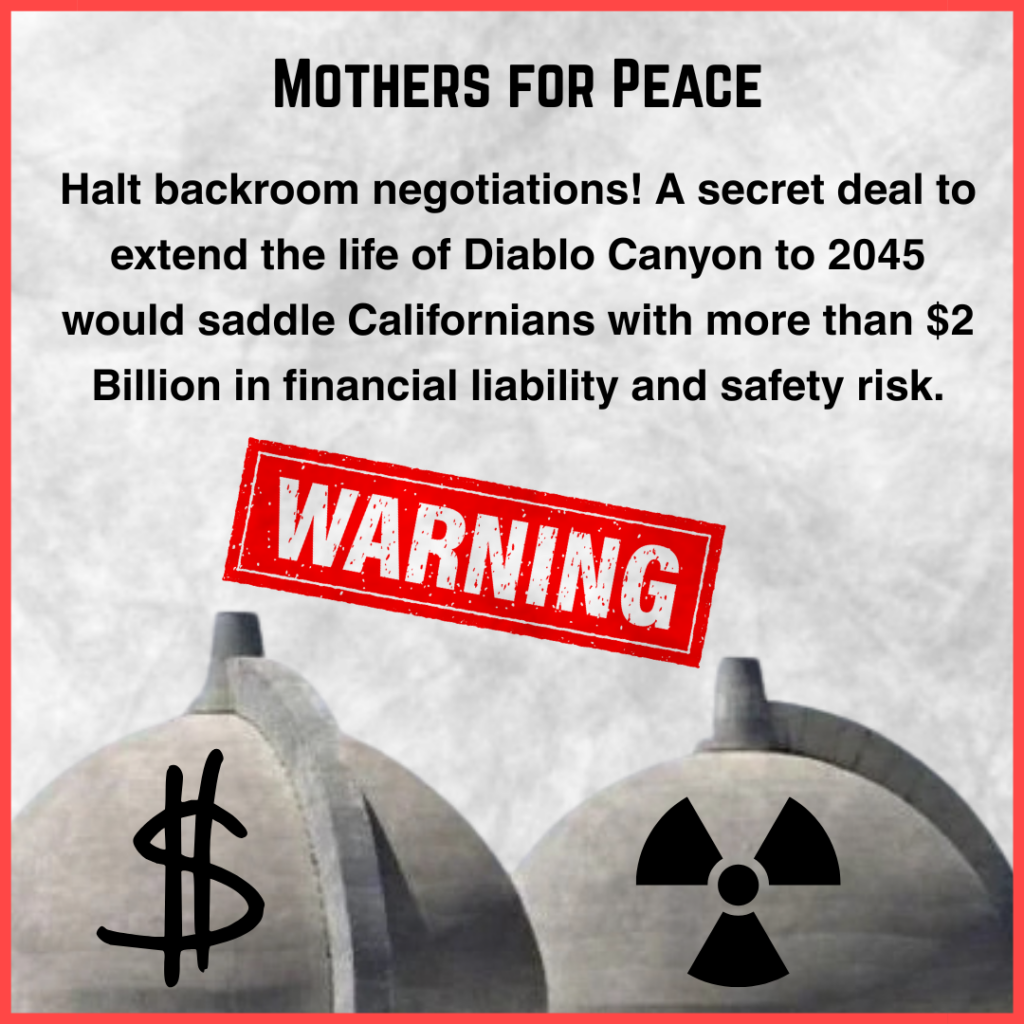
SAN LUIS OBISPO, CA — A backroom deal is taking shape in Sacramento that could keep the Diablo Canyon Nuclear Power Plant running until 2045—and stick California taxpayers and ratepayers with billions of dollars in costs and risk. Mothers for Peace, along with more than fifty other environmental and consumer organizations, is demanding that any proposal to extend the plant’s operations beyond its agreed-upon 2030 closure date be subject to full public hearings, independent fiscal analysis, and open legislative debate.
The coalition has formally written to Governor Gavin Newsom, Assembly Speaker Robert Rivas, Senate Pro Tem Toni Limón, and members of the California Legislature, warning them not to repeat the closed-door process that generated Senate Bill 846 in 2022. That last-minute deal extended Diablo Canyon’s operational life to 2030 and has already proven financially damaging to Californians.
“We’ve seen this movie before—a last-minute deal and no public input that has Californians left holding the bill, Linda Seeley, Mothers for Peace spokesperson, said. “Extending Diablo Canyon for another 15 years will cost billions more in public funding, create long-term ratepayer obligations, and cause serious safety risks. Californians deserve transparency, not another deal negotiated in the dark,” she added.
The warning from SB 846
Mothers for Peace, which has fought to close Diablo Canyon for more than 50 years, points to SB 846 as a blueprint for what goes wrong when the Legislature operates behind closed doors. The bill was introduced, negotiated, and enacted in the final days of the 2022 legislative session, with no meaningful public review or policy committee deliberation.
The consequences are already severe. The state’s $1.4 billion loan to support Diablo Canyon operations is effectively spent—approximately $1.33 billion has been disbursed directly to PG&E, and there is growing evidence it will never be repaid. To add insult to injury, a University of California, Santa Barbara study released recently, found that PG&E, Diablo Canyon’s owner, inflated the capital upgrade and operational costs used to justify the deal. And SB 846’s failure to reconstitute the plant’s Unitary Tax has left the San Luis Coastal Unified School District with a $10 million budget deficit.
The loan is only the beginning. Layered on top are a $100 million annual management fee paid simply for keeping the plant running, performance payments, volumetric payments projected to yield PG&E an additional $1.4 billion, and a $300 million ratepayer-funded Liquidated Damages Account. Together, these mechanisms represent more than $2 billion in additional public exposure beyond the original loan, while shifting nearly all financial risk away from PG&E and onto ratepayers and taxpayers.
Even with potential federal Department of Energy support, analysts project taxpayers could still be responsible for at least $659 million in unrecovered costs—and this is just through 2030. No estimates are available for the costs beyond that date.
All of this while PG&E posted a record profit of $2.59 billion in 2025—its third consecutive year of record earnings—as California ratepayers already pay some of the highest electricity rates in the nation.
A deal taking shape behind closed doors
Despite the Legislature’s policy committee deadline looming, no bill has been publicly amended to include a Diablo Canyon extension. However, there is still time for a bill to become the vehicle for a deal to include the extension. Alternatively, the extension could emerge as a last-minute trailer bill in the June budget, bypassing policy committees entirely. Both scenarios, the groups argue, would be just as unacceptable as the SB 846 process.
State Sen. Ben Allen, chair of the committee on energy, utilities and communications, expressed concern about a backroom deal. He told KQED: “if there is a need to keep Diablo online, I want to have real frank conversations about what we’re doing to improve clean energy buildout so that we won’t be so reliant on this money pit that requires subsidies by ratepayers statewide, not just PG&E customers.”
Safety and fiscal risks demand open debate
A 15-year extension would also leave unresolved serious safety concerns, including reactor embrittlement, spent nuclear fuel management, and seismic risk as the plant sits on a web of earthquake fault lines.
“SB 846 didn’t just hand PG&E a financial windfall—it stripped away the oversight designed to protect the public. Expedited permitting and curtailed environmental review mean state agencies cannot fully evaluate what they’re approving,” Diane Curran, attorney for Mothers for Peace, said. These unresolved safety issues—reactor embrittlement, seismic risk, spent fuel with nowhere to go—aren’t just safety concerns. Under this deal’s structure, every one of them is also a financial liability that lands on taxpayers and ratepayers, not PG&E,” Curran explained.
Mothers for Peace is calling on the Legislature to:
- Hold full policy committee hearings in both chambers on any Diablo Canyon extension proposal.
- Conduct budget committee review given the detrimental fiscal implications for taxpayers and ratepayers.
- Commission independent analysis of all safety, environmental, and fiscal risks, including seismic risk, reactor embrittlement, and spent fuel management.
- Ensure meaningful public participation and transparency before any vote is taken.
- Reject any last-minute gut-and-amend legislation or end-of-session budget maneuvers that bypass proper deliberation.
You can read the full letter to the Legislature here. Along with the letter, a cost fact sheet and report from Rao Konidena were attached.