
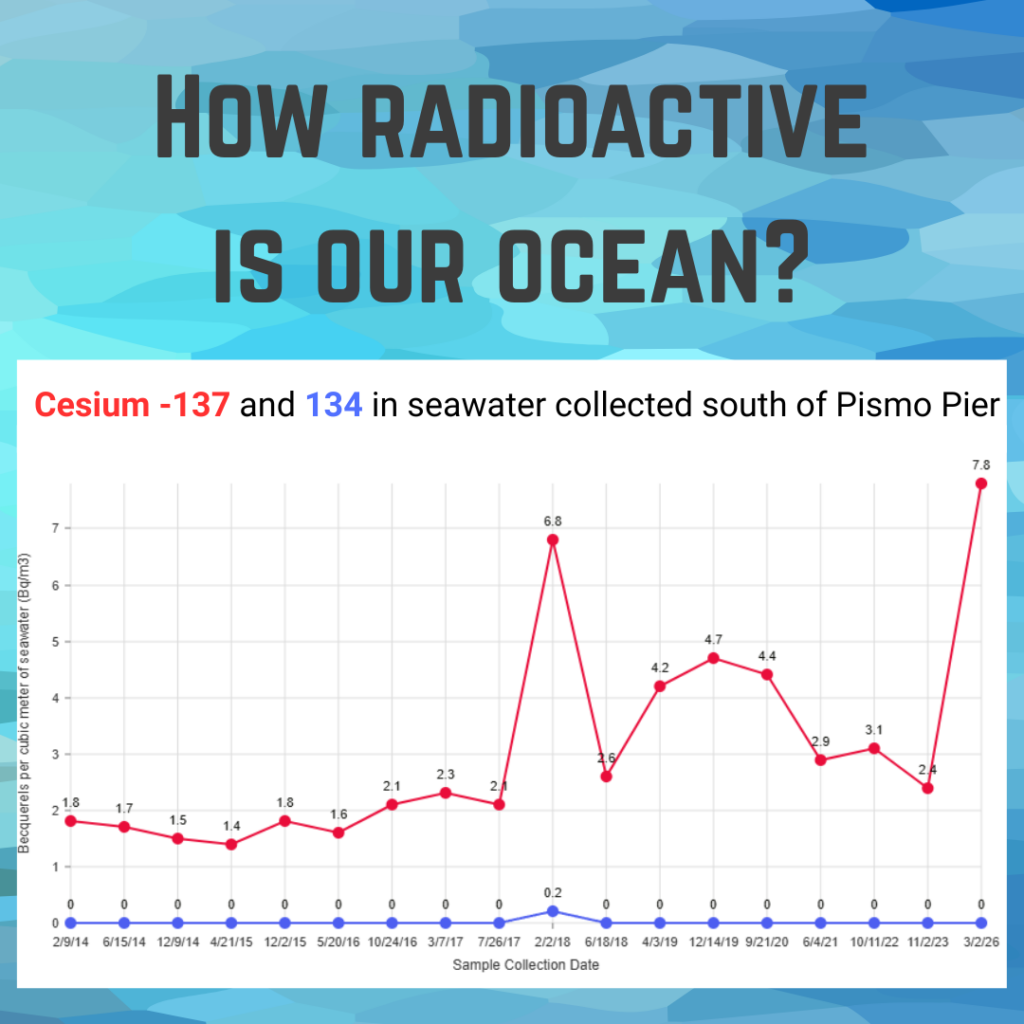
Beginning on February 9, 2014, San Luis Obispo Mothers for Peace (SLOMFP) has been taking 5-gallon samples of seawater at the Pismo Beach Pier and sending that water to the Woods Hole Oceanographic Institute (WHOI) to be tested for cesium-134 and cesium-137. The focus on cesium is because it was one of the most abundant radioactive contaminants released, and some forms can remain in the environment for decades. Cesium-134 has a relatively short half-life of about two years, meaning it decays more quickly and is a strong indicator of recent contamination. In contrast, cesium-137 has a much longer half-life of about thirty years, allowing it to persist in the environment for decades and accumulate over time.
It is important to note that, prior to massive earthquake and subsequent tsunami in 2011, there were already measurable amounts of radioactive fallout in the ocean from the testing of nuclear weapons that peaked in the 1960s. For cesium-137, levels in Pacific Ocean surface waters were generally below 2.0 Becquerels per cubic meter (Bq/m3).
As we continued to take samples about every six months, we saw the levels of cesium-137 rise. Between July 2017 and February 2018, the cesium-137 level rose from 2.1 Bq/m3 to 6.8 Bq/m3. Cesium-134 was also detected for the first time. This increase, as well as our finding of cesium-134 in these elevated samples, provided clear evidence that Fukushima contamination had reached our shores.
We have taken eight samples and sent them to WHOI for testing since 2018. The cesium-137 levels did drop down but not to the same levels they were before the spike. They went from being in the 2s to being in the 4s then began to drop a little more between 2021 and 2023. There was then a gap in sampling between November 2023 and March 2026. The results from March 2026 show a significant increase, with cesium-137 levels rising by 5.4 Bq/m³ compared to the previous sample. This sharp increase raises serious concerns and warrants further investigation.
Notably, Japan began discharging treated but still radioactive wastewater from Fukushima into the Pacific Ocean on August 24, 2023. The timing of this discharge and the subsequent increase detected in our March 2026 sampling underscores the urgent need for expanded, transparent, and independent monitoring of ocean water along the California coast.