
Experts Brief California Lawmakers on Cost, Reliability and Safety Risks of Extending Diablo Canyon Beyond 2030
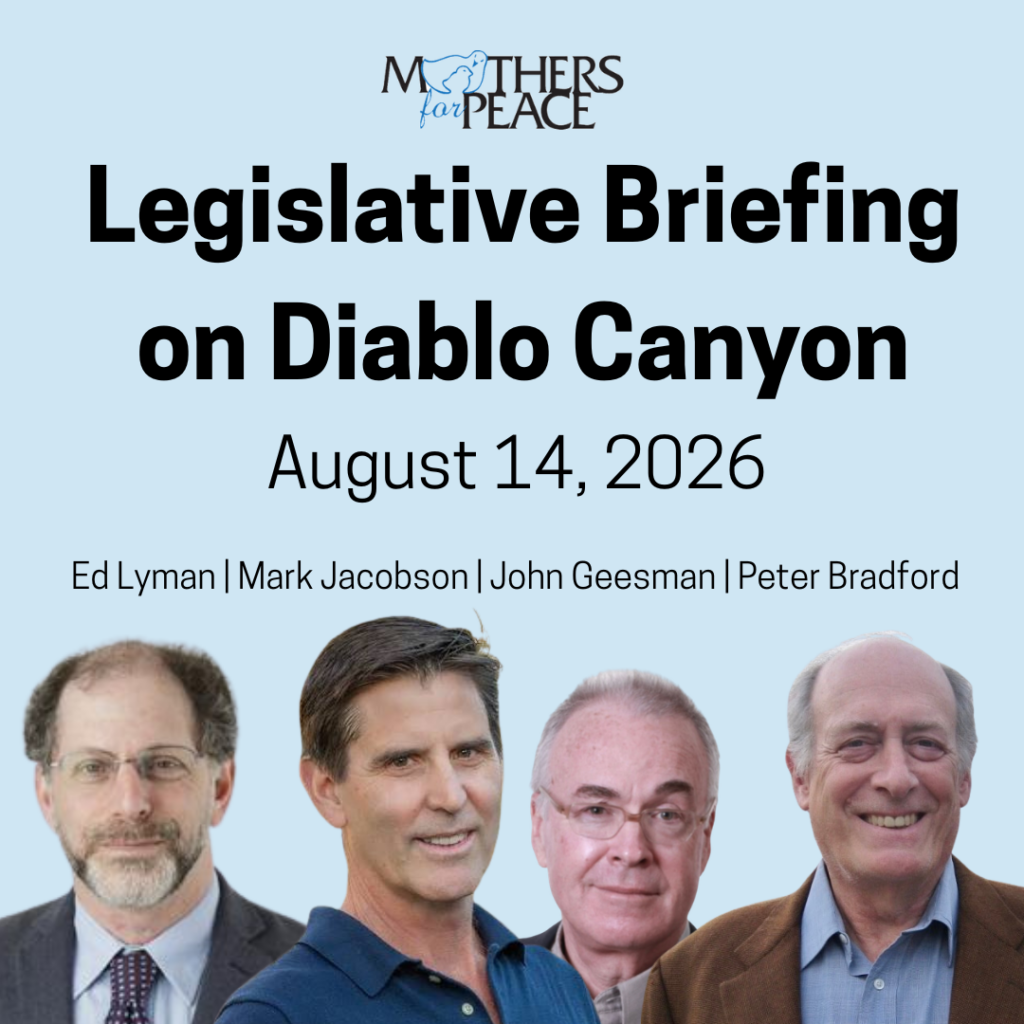
As efforts to extend Diablo Canyon Nuclear Plant beyond its current 2030 operating deadline move toward the next legislative session, energy, regulatory and nuclear-safety experts are urging California lawmakers to closely examine the plant’s costs, role in the state’s energy system, federal safety oversight and protections for ratepayers and taxpayers before making another long-term commitment.
Watch the full Aug. 14 briefing here.
Approximately 25 California legislators’ staff attended the briefing, “Diablo Canyon Through 2045? What California Lawmakers Need to Know About Regulatory Prudence, Cost and Reliability,” which was moderated by Kim Delfino, President and Founder of Earth Advocacy, and co-hosted by San Luis Obispo Mothers for Peace, Sierra Club California, California Alliance for Community Energy and California Environmental Justice Coalition.
The expert speakers focused on four central questions:
- What would continued operation cost California ratepayers and taxpayers?
- Will Diablo Canyon still be needed for energy reliability beyond 2030?
- How should changes in federal nuclear regulation and safety oversight factor into the state’s decision?
- And what standard of prudence and accountability should lawmakers require before approving another extension?
John Geesman — Cost, ratepayer and regulatory analysis. An attorney at Dickson Geesman LLP and former California Energy Commission member, California Power Exchange chair and California ISO board member, Geesman focused on the financial implications of continued operation. He said PG&E forecasts a $595 million deficit for 2027, bringing the cumulative shortfall since extended operations began in November 2024 to $1.7 billion.
“Diablo Canyon is what the financial world calls a ‘stranded asset,’ meaning that the plant persistently falls short of covering its costs with the market revenues it receives for producing electricity,” Geesman said. As a result he pointed directly to who could be left covering some of those costs: “PG&E now admits that its grant payments will fall short by at least $659 million, and its CEO says taxpayers should absorb that loss.” he added.
Mark Z. Jacobson — Energy reliability, renewables and storage. The Stanford University professor of civil and environmental engineering examined Diablo Canyon’s role as California expands solar, wind and battery storage. Jacobson presented data showing that the plant’s inflexible generation is contributing to increased curtailment of renewable energy.
“Diablo Canyon is forcing wind and solar off the grid,” Jacobson said. “So you’re just paying for wasted electricity.” He summed up the data this way: “The direction is clear that renewables decrease electricity prices; fossil fuels and nuclear increase prices on grids.”
Edwin Lyman — Nuclear safety, security and NRC oversight. The Director of Nuclear Power Safety at the Union of Concerned Scientists focused on changes at the U.S. Nuclear Regulatory Commission (NRC) and what they could mean for federal oversight of Diablo Canyon. He noted a pattern of reduced inspections, unresolved seismic risks and potential changes to safety and security requirements.
“Every state, California included, that has operating nuclear power plants needs to understand that they can no longer rely on the federal agency, the NRC, to protect public health, safety and the environment,” Lyman said.
Peter Bradford — Prudence, licensing and regulatory accountability. A former NRC commissioner and former chair of the Maine and New York utility commissions, Bradford criticized the California Public Utilities Commission for failing to adequately assess the costs, risks, benefits and alternatives to continued operation for the five-year extended term that expires in 2030, and cautioned that a thorough analysis was essential before considering another extension.
“Prudence has been a crucial customer protection term in utility regulation for the last 100 years,” Bradford said. “The requirement that customers not pay for imprudently incurred costs is the ultimate safeguard against imposition of costs that have not been adequately evaluated or controlled.”